



























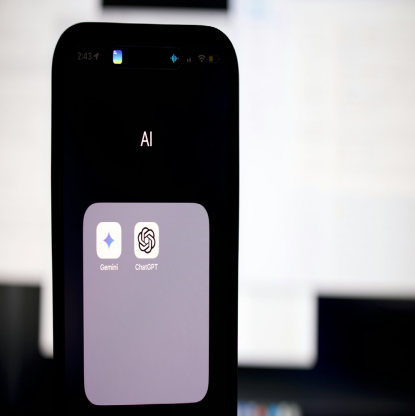
Artificial Intelligence (AI) is a broad concept that involves creating machines capable of performing tasks requiring human intelligence. AI is a powerful tool, and like any tool, its impact depends on how it is designed and used. Freshman Owen Ginsberg said, “I think AI is a very useful tool, but when it is used excessively and for everything, it sometimes gets information that is not correct.” The benefits of AI can be significant; in the article “Nine Benefits of Artificial Intelligence (AI) in 2025” on the University of Cincinnati’s website (online.uc.edu), benefits can include enhanced health care, scientific discovery, and enhanced cybersecurity. The Harvard Medical School (harvard.edu) reported, “When we talk about the application of AI, we can think of applying it across the entire spectrum of health care specialties, from the administrative side through to clinical care.”
Today, AI is changing and enhancing health care, from automating routine tasks to improving diagnoses and accelerating the discovery of more effective treatments. AI can help clinicians interpret results more effectively. For example, AI can be used to interpret electrocardiogram (EKG) and CAT-scan results, and it can be used to identify irregularities in such tests. AI can also assist health care organizations in improving quality and safety. For example, Harvard Medical School researchers have used AI software to review a large amount of data and quickly remove large amounts of data, easily identifying patients at elevated risk of developing sepsis.
AI could also bring about new possibilities for science and enhance what humans and researchers know about the world. AI helps to accelerate scientific insights. Greener Group Landscape Project Construction Manager Steven Chung explained, “AI will help all or most scientists with their research by helping carry out tasks by cross-referencing data to keep abreast of new discoveries and new information.” As posted on Microsoft’s website (news.microsoft.com), AI helps scientists speed up research, manage substantial amounts of data, and perform complex simulations much faster than humans could. Microsoft’s version of AI acts like a research teammate and automates tasks such as forming hypotheses, running simulations, and improving experiment results. AI can play a key role in the way humans and researchers produce, store, and use energy, by optimizing current systems and aiding in the development of new ones. For example, Microsoft used AI to screen more than 32 million candidates to discover new material that could reduce lithium use in batteries by up to 70%.
AI can also significantly enhance cybersecurity by strengthening threat detection, response, and prevention capabilities. According to the article entitled, “What Is Generative AI in Cybersecurity?” on the Palo Alto Networks website (paloaltonetworks.com), AI’s significance in cybersecurity comes from its ability to process and analyze substantial amounts of data in the most effective and accurate way. This enables enhanced threat intelligence to automatically respond to an event or request without human involvement, and to actively search for weaknesses in systems before hackers can find and expose them. AI can also uncover subtle indicators and compromises that human analysts might miss. Machine learning models analyze historical attack data and current threat intelligence feeds to identify emerging patterns and predict future attacks. This predictive capability allows organizations to strengthen defenses against threats in the future.
As AI continues to evolve over time, its impact will grow further as it has already become an essential part of everyday life. Freshman Gavin Stark commented, “I think it’s great that AI is evolving; I think it can help with a lot of things like work, schoolwork, and anything really. I don’t think there is going to be any huge problem with it advancing.”