





















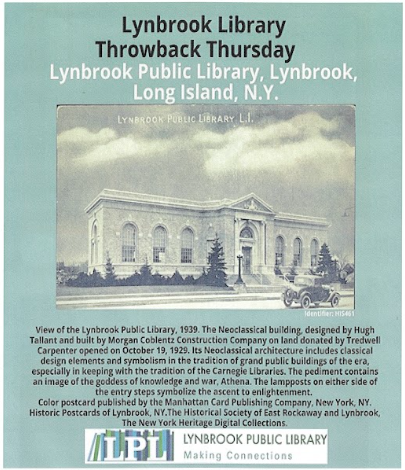
The Lynbrook Public Library is celebrating a recent victory: being added to the National Register of Historic Places. This is an accomplishment, as the librarians have been applying for five years. The library was added to the state registry on March 13, 2025. Finally, the Lynbrook Public Library was added to the National Register of Historic Places just recently on August 27.
Library Director Robyn Gilloon said, “It is very exciting because it recognizes the building’s great architecture, and now it is a statement within the community.”
Reference Librarian Kathleen Curran said, “The Library was started by a group of women named ‘The Friday Club’ who founded the first library in Lynbrook; it moved to several different places until it was built in the current location.” “The Friday Club” was an assembly of women who dedicated their time into fighting for women’s suffrage, women’s literacy, and women’s civic engagement in Lynbrook
The original creator of the current Lynbrook Public Library was Hugh Tallant. “He was an architect who studied at the Ecole des Beaux art school in France before he built many landmark buildings in the city,” mentioned Curran. A few revolutionary buildings Tallant constructed in the city include the New Amsterdam Theater, the Lyceum Theater, the Brookland Academy of Music, and several private residences. Curran added, “He was a specialist in acoustics; he wrote articles on acoustics, and that’s why the auditory range is so good in the old building.” The old building Curran referred to is the portion of the current library that is original to the time of 1929, when the building was much more compact than it is today.
In October 1956, Custodian Charles H. Sharp intentionally set the library ablaze, only causing damage to the interior of the building. “They had to refurbish some of the furnishing, not the building itself,” Curran said. She added, “The outside is all original still; it is completely intact, and there is a drop ceiling, which I’m sure wasn’t there to begin with, but the rest is all original.” The recovery after the arson attempt was quite costly, but the innovative architecture remained standing. Curran later remarked that the focus should be on the architecture of the building rather than the custodian incident because that is why the library qualifies to be added to the National Register of Historical Places. The original proposal for the National Register of Historic Places was made by Lynbrook Village Administrator John Giordano. In the application he wrote, “We can trace the origins of the Lynbrook Library to an era of tremendous social change represented by the development of women’s organizations, the education of women and its impact on society.” He is referencing the women’s suffrage movement where women gained the right to an education and the rights to participate in government affairs. Regarding the architecture, Giordano said, “the Lynbrook Library displays the signature Carnegie elements of elevated formal entrance welcoming patrons to enter through a prominent doorway, accessed via a staircase.” He also mentioned later in his writing that Athena is engraved on the pediment, signifying wisdom and knowledge. Giordano added, “Nearly all of Carnegie’s libraries were built according to ‘The Carnegie Formula.’” The formula he referred to is that the community in which the library was to be built had to demonstrate need, a site on which the library was to be built, annual funding, free public access, and had to be well maintained.
In order to be accepted to the National Register of Historical Places, certain criteria need to be met. “The library represents an important style in architecture which is the Neoclassical revival of Bossart’s movement and the famous architect in that crusade,” remarked Curran. This uniquely detailed style is a mix of Greek and Roman architectural formulae. Curran correspondingly said, “There are a lot of government buildings in this same style, and then they started using it for educational buildings, like libraries and museums, because they wanted to put it to the same status as a government building to show that it is very important to the community.”