

























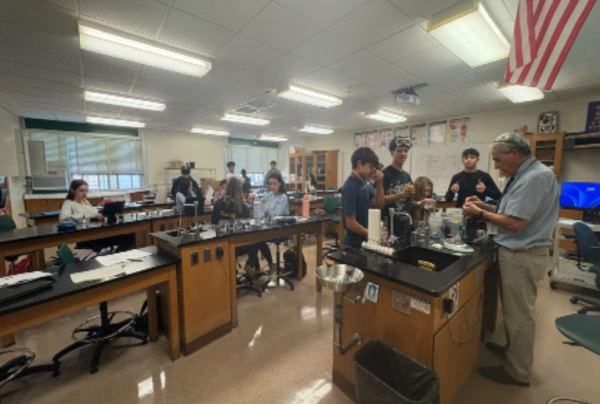
For many decades at LHS, physics or AP Physics was a required prerequisite for AP Chemistry or AP Biology. This policy changed for the 2025-2026 school year when the physics requirement was revoked, allowing juniors and seniors more flexibility in choosing science classes as upperclassmen. There appear to be some mixed thoughts on whether this decision is positive or negative for LHS students.
Despite no longer being a requirement, taking a physics class in one’s high school career has proven to have positive results. According to the article “Applications of Physics in Everyday Life” on the Geeks for Geeks website (geeksforgeeks.org), scientists said, “Physics plays an important role in shaping our everyday experiences, from the simplest actions to more complex tasks. Whether it is walking, driving, or using electronic devices like a phone, the principles of motion, force, and energy are constantly at work. Physics is not just for scientists – it is part of our everyday lives.” Some senior students are upset with the fact that they took physics last year, as they were under the impression that it was required to take AP sciences. Jake Mehta, a senior, expressed, “I think [the change] is annoying because I took [physics] last year.” Other students are happy that they had to take physics. Senior Cathlyne Cueto, who took AP Physics and AP Chemistry as a junior and takes AP Biology as a senior, expressed, “I observed that there was not an overlap in content, so the material taught in AP Physics is not necessary. Despite this, I encourage students to take physics during their high school careers because it offers students a challenging and rewarding experience.”
Studies have shown that learning physics can help the brain function, use critical thinking, and learn complex problems to help exercise the brain. According to the article “Learning Physics Changes How Your Brain Works” by IFLScience (iflscience.com), following completion of the physics course, new areas of the brain lit up. Activity in the frontal poles increased, and a region known as the posterior cingulate cortex became active too.” Teachers have also expressed similar opinions in regard to this research. When asked how she felt about this policy change, physics teacher Amy Ezagui expressed, “I am not in support of this decision because I strongly believe that physics is an important course for any college-bound student to take. Physics is a fundamental science that underpins chemistry, biology, and all other science-related fields like geology, meteorology, and environmental science. Understanding concepts like energy, forces, and thermodynamics is crucial for advanced study in these areas.” Ezagui added, “[Physics] is often called the ‘mathematical science’ because it provides practical, real-world applications for algebra, geometry, and eventually calculus, strengthening mathematical reasoning and problem-solving abilities, which is beneficial for other subjects and standardized tests like the ACT and SAT.”
When asked how this change will affect future students, Ezagui conveyed, “Taking a rigorous high school physics course can provide a stronger foundation for college-level physics and other STEM majors, which often require it. It can make a student a more competitive applicant at selective colleges, especially if they plan on a STEM or health science path. If students are opting out because it is no longer required to take AP science courses, they are missing out on these important benefits.”
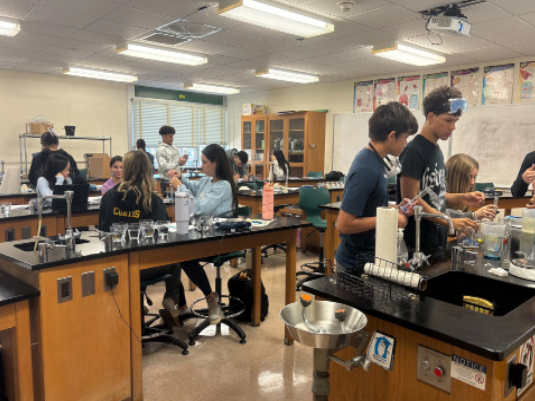
While this new policy may create a dip in student enrollment in physics, some people pointed out the benefits of this change. This new plan gives students more flexibility for their upperclassman years. Students who may want to study biology or chemistry in college can now have those completed courses on their transcripts, as well as their AP scores. Giovanna Cerino, a junior, expressed her opinion on eliminating the physics prerequisite: “I think it is good because it helps students take classes they want to study, and if they don’t like physics, they don’t have to take it.” Cerino continued, “This opens doors for seniors applying to college, allowing them to show more experience in the fields and a higher chance of getting into the programs they desire.”
Many who take AP science during the junior year will also take science during the senior year, meaning physics may still be taken during one’s high school career. Despite mixed reviews, LHS did not make this decision lightly. When asked how this decision was made, Guidance Department Chairperson Sue Moller explained, “In terms of balancing rigor with what makes sense for pre-reqs, we decided to try this. We wanted to give the option to take more AP [classes] if [students] wanted to, but I was not involved in the decision making.” In response to how long this decision was in the works, Moller said, “…more recent, probably in the last two years or so.” Finally, when discussing whether this decision would benefit all students, Moller explained, “Not necessarily… colleges are looking for the four main breaths of science.” She added, “Students who are looking into psychology, English, political science, or business do not need physics.” Moller concluded, “Anyone who is looking into the sciences… has to have physics.” Students are advised to select courses that best align with their academic goals.